How to do line balancing (dedicated lines)?

Line balancing is a power tool to remove waste if you do it properly. Here are four steps for balancing a dedicated line (versus a shared or mixed product line) by using a simple example:

1. Identify the process steps, materials and process time. This step is usually done using a Process Graph (see figure 1.)
Figure 1
A Process Graph depicts each material or component in the sequence they are assembled together to create the final product. The process time at each assembly or process step is also included. 
In the figure 1, materials and components are in blue (i.e. "Tubes") starting from top to bottom and from left to right. Assembly steps (i.e. "P1") are in yellow while the process time (i.e. "16 seconds") are in green. 
For example, process P1 take 16 seconds to assembly Tubes using screws while process M2 requires the sub-assemblies completed by process M1 and P2 and it takes 6 seconds.
The final assembly is presented at the bottom (i.e. "Assembled Plug") 


2. Calculate the takt time. Takt time gives you the production time required to meet the customer demand (the pace of the demand.) For our example we will assume 29 seconds per plug

3. Group operations. Starting at the top of the process graph (figure 2), add the the process time until the total time is equal or less Takt time. In the example, 
Figure 2
  • Workstation 1: P1+M1+P2+M2 = 29 seconds
  • Workstation 2: M3+M4 = 28 seconds
  • Workstation 3: M5+M6 = 28 seconds


4. Build a Balancing Chart or Yamazumi Chart by using magnets or post-it for each process within each workstation operation as shown in figure 3.


How to use the Balance Chart? 
The benefit of building a Yamazumi or Balance Chart is that actually you can "see" waste and opportunities for improvement. For instance,

  • Any improvements to reduce the total cycle time in workstations 2 and 3 will not increase the overall line's throughput. In fact, improvements in these two stations will create more waste as idle time or waiting which is one of the 7 deadly wastes. Why? Because workstation 1 is the bottleneck (the one with the longest cycle time) "holding" the flow of production to 29 seconds even workstation 2 and 3 can run faster. 
  • On the other hand, workstations 2 and 3 have 1 second each per every cycle. if we improve workstation 1 to 28 seconds, the overall line can produce one unit every 28 seconds. In that case, the line is evenly balanced and there is not waiting time. 
  • However, if each workstation produces at 28 seconds, the line will be overproducing  given that the takt time is 29 seconds. As you might know, overproduction is the worst waste as that would create additional waste such as inventory, transportation and others.    

What can Americans and Scottish whiskey distilleries learn from the car industry?

These days Americans and Scottish whiskey distilleries might feel uncomfortable on the news that the title of the finest whiskey in the world has been given to their Japanese competitor (The telegraph Nov 4, 2014.)
The Yamazaki Single Malt Sherry Cask 2013 became the "World Whiskey of the Year" out of 4,500 others by the recognized connoisseur Jim Murray. However, this prize is perhaps just the tip of a long learning and continuous improvement journey. Yamazaki has been doing whisky since 1923 in Japan and "Japanese distillers regularly wins whiskey competitions, even in Scotland" (Washington Post Nov 5, 2014)
How an Asian maker is beating its Scottish and Americas such as Jack Daniels in a craft that has been part of their history and tradition for hundreds of years?

Searching for an answer, I found little written about the reasons behind the Japanese whiskey successes. In an article at qz.com, its author mentions two reasons: (1) a less rooted tradition that allowed experimentation and (2) good quality water:
"New York Magazine’s Jordana Rothman points to the youth of Japan’s whisky industry, which she says makes it “less shacked to tradition.” Yamazaki also has the benefit of its mineral water which “is treasured enough to be bottled and sold on its own.” Its wood barrels, meanwhile, are made of a native oak, mizunara, which Rothman writes “impart an almost ecclesiastic perfume you won’t find in any Scotch.”
More than just great quality water
While the lack of tradition and the availability of great quality water may be necessary to create the finest whiskey in the world we must recognized they are absolutely not sufficient. Industry experts should look deeper and perhaps learn from the challenges of their counterparts in the car industry.

In the 70's and 80's, the American and European automobile industry faced a similar situation when Toyota challenged the status quo of the well established big 3 (GM, Ford and Chrysler.) It took several decades and a billions of dollars for these companies to recognize that need for change. It was in this context that the Toyota Production System was studied by MIT and other universities for the benefits of a diverse range of industries far beyond just the car industry or even manufacturing. Are there lessons learned from the car industry that whiskey makers should review? Or are they doomed to repeat the same struggles?

Feeling uncomfortable is not pleasant but it can be a great source to propel innovation and growth for all, even for people who don't drink or care about whiskey. What do you think?

Organizing a Lean office workplace

"Where do you want me to go now?"
When helping teams to improve their office or transactional operations (i.e. Stanley Black & Decker) I have been asked 'How should an office be organized to make value flow towards our customers with the minimum cost, time and errors?' 

Although there are well proven solutions for organizing manufacturing workplace such as implementing U-shaped cells to tear down large batch production lines, little has been shared about designing office space using Lean principles. This post is an initial effort to address this void by discussing some important findings and sharing examples from companies such as Kaas Tailored in the US and HOKS in Japan that I had the opportunity to visit thanks to the Kaizen Institute.

How office workplace affects teams performance
In the 70's, MIT professor Thomas Allen led a series of experiments to understand what factors make some teams more innovative and effective than others. He discovered that the most relevant factor shared by innovative and highly effective teams is their physical proximity. In other words, teams that have their members very close are much more effective than similar teams that have their team members farther away.
The explanation behind this finding is based on how team members exchange critical information. Professor Allen found out that interpersonal communication rather than technical reports, publications, email or any other written documentation is the common means how teams collect and transfer relevant information. In practical terms, any documentation is most useful when knowledgeable people is directly available to explain and supplement its written instructions or content.
In this way, office spaces where people are separated by walls, cubes or other physical structures have lesser interpersonal communication and thus lower overall performance. On the other hand, workplaces in which people can quickly and effectively communicate allow teams to be more effective.

Professor Allen's conclusion supports the importance of information flow in an office environment. However, based on this finding, how should be set a lean office workplace be organized? Before answering this question let's review two relevant studies about workplace and team effectiveness.

Developing smarter teams
In 2010, two academics from MIT identified that the smartest teams, better decision makers teams, were distinguished by three characteristics: (1) their members contributed more equally to the team's discussions, rather than letting one or two people dominate the group, (2) their members can better read emotional states, and (3)  more women team members. This last characteristic, as explained by the study, it is not about diversity but related to the fact that women are better at reading emotions. What these findings have to do with a office workplace? A lot. Any office space that allows members to contribute equally and to better read their emotional state would definitive develop smarter teams.

On-site versus online work
How online collaborative tools (Skype, email, etc.) would affect the way we organize office workplace? A new study from MIT Center for Collective Intelligence identified that emotion-reading matters just as much for teams online teams or off-line. They findings indicated that it is not physical proximity but emotional perception what make the difference. However, reading emotions is much harder using  a phone, email or Skype than in a face to face conversation.

Examples for creating lean office workplace:

I. Kaas Tailored USA
Kaas Tailored is a company with many years practicing kaizen (continuous improvement.) Their office space has several interesting solutions from which we can learn a lot.  


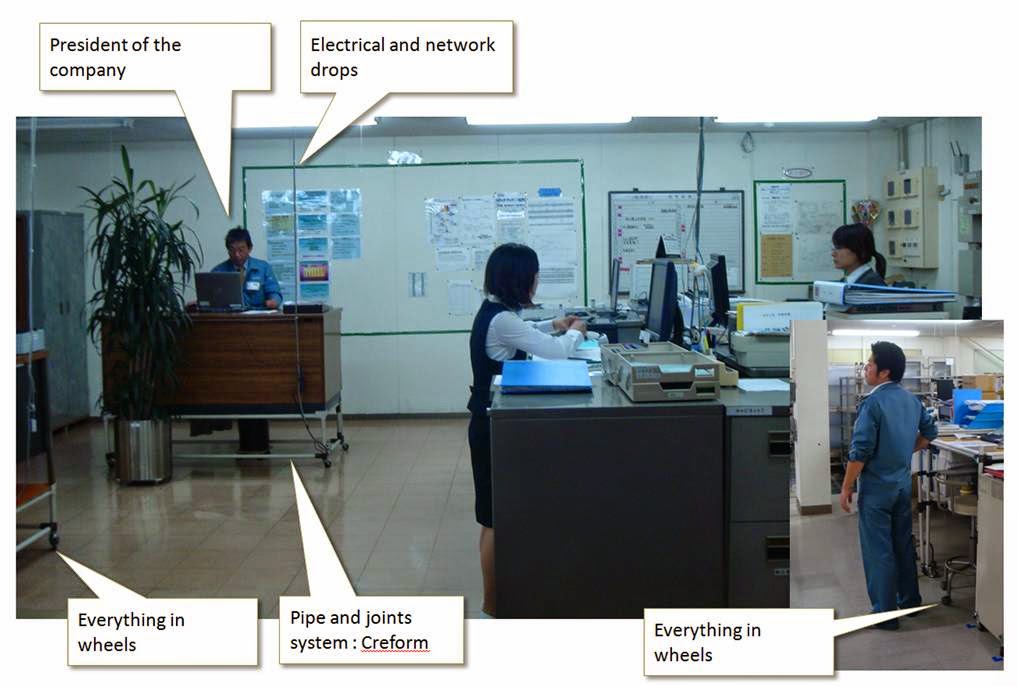
  • Avoiding stopping communication flow. Contrary to traditional office space, their office layout does not have cubes or walls. The desks are organized forming a circle allowing information to flow quiet efficiently by rolling their chairs or just walking. 
  • Health and flow. Desks are high enough so people can work standing-up; however, they have high chairs if they wish to sit. There is a lot of evidence that sitting for long periods of time is bad for our health so stand-up desks with high chairs appear a great solution from health and flow perspective. 
  • Continuous Improvement. The office space is designed for experimentation.  Power, network and phone cables are "dropped" so changes in the layout are easy to implement by the associates with limited need of facilities or contractors. Note that all desks are wheeled.
  • Visual. The space is immersed in visual clues. By just standing, you can have a good idea of the information flow.


These workstations are built using a flexible system based on tubes and joints that can be put together by anyone with non or little experience and few simple tools. In this way, people can take ownership on improving by their own, allowing faster cycles of experimentation and improvement. Some well known providers in the US and Europe are:
   - Creform, www.creform.com
   - Fastube, www.fastube.com
   - NIS, www.nisusa.com
   - Flowstore, www.flowstore.co.uk

Although most of these systems were original created for manufacturing, they are evolved and used in hospitals, retailers and offices in general as you see with Kaas Tailored above.  

II. HOKS (Japan)
Another company with many years applying Kaizen principles is HOKS. Their policy is that anything, even vending machines, must be in wheels so continuous improvement can easily be done by all associates. As in Kaas Tailored, you can see people working standing-up with high chairs by their sides. In this case, a cost effective solution was use to increase the high of traditional desks.

Should you have a Master Black Belt in your Lean Six Sigma transformation?

The role of Master Black Belts (MBBs) is a point of controversy, confusion and even frustration. The lack of a common standard on their role, the proliferation of different organizations offering MBB certifications and the late response of the ASQ to put together a Body of Knowlege (BoK) for MBB did not help. 

The role of Master Black Belt according to ASQ
The ASQ MBB Body of Knowledge reflects a positive evolution of the Master Black Belt role. The statistical and probabilistic acumen, characteristic of Six Sigma practitioners, have been complemented by a significant doses of project management and mentoring concepts. It cautions MBBs from becoming just statistician experts to actually embrace the role of agents for meaning change at all levels of the organization.

ASQ have done an outstanding work. The topics included in the ASQ MBB body of knowledge provide a great guide to Six Sigma practitioners to understand the role that MBBs:
  • Enterprise-wide planning and deployment (25%)
  • Cross-functional competencies (15%)
  • Project management (15%)
  • Training design and delivery (10%) 
  • Mentoring responsibilities (10%)
  • Advanced measurement methods and tools (25%)
In addition, the percentage of questions, values in parenthesis, set by ASQ for each topic gives a clear direction on the relative time that MBBs might spend their role when helping organizations. with 75% dedicated to alignment, planning and mentoring. Even further, the level of mastering of each topic, as presented by ASQ using Bloom's taxonomy, ensure that topics included in the body of knowledge are treated well aligned with the expected role of MBBs. 

Beyond Six Sigma Training and Project Management 
However, the ASQ MBB BoK has its limitations. The highest level of mastering in Bloom's taxanomy, "create", is mainly assigned to project and training management topics shown below: 
  • Pipeline management
  • Leadership for deployment 
  • Executive and mid-level management engagement (project engagement)
  • Project status communication 
  • Project management infrastructure
  • Training plans
  • Training effectiveness evaluation
  • Project reviews (Mentoring champions, change agents and executives)
  • Mentoring belts and non-belt employees
While a solid foundation for training and project management for any Six Sigma MBB practitioner are clearly necessary, the role of any MBB must refocus on becoming a transformational leadership role. The success and failures of the Six Sigma efforts in Motorola, Xerox and GE should be review to strengthen the role of Master Black Belts towards the success of their organizations.Why Motorola failed despite its Six Sigma successes and brilliant Master Black Belts? More analysis is needed but it is evident that Six Sigma project and training management expertise can't create sustainable adaptive organizations.

To Be or Not To Be: The MBB question for your organization
Should you include a Master Black Belt in your Lean Six Sigma deployment? It depends of many factors. For instance, "Belt" titles bring positive and, unfortunately, negative memories to cost cutting projects that meant firing people in some instances. In either case, you need to account for the connotation that MBB could mean in your organization; However, regardless whether you call it MBB or not, the transformational role is necessary to ensure Lean Six Sigma efforts last beyond the initial euphoria 

Learning SMED (Quick Changeover) Through Simulations

Many studies show that a guided practical application is more effective than just PowerPoint presentations. That holds true when teaching Lean tools and concepts. However, finding good Lean simulations has been difficult. Here are some of the available resources that you can use to teach SMED:

  • SMED DIE simulation game: This Slideshare shows a nice, simple and practical version of a SMED simulation game. I learned this simulation from the Kaizen Institute Europe team few years ago. It really helps to explain the SMED steps very well. Since then I have been using this simulation with good results. It usually takes about 2-3 hours to go through all the steps. You can purchase it. An alternative metal version of this simulation game is also available in Slideshare but you would have to build your own.
  • SMED printing simulation video 1: This video shows an alternative version, a little more complex though, but still simple and practical. I learned about this video last week thanks to Laszlo Sipos. 
  • SMED printing simulation video 2: This version developed by a UK-based team appears to be a fun but a little more complex option. Jose dos Reis Vieira developed a SMED printing simulation that resembles the previous simulation. Here are two videos: Before and After

Breakdown into elements during
a SMED kaizen event
Regardless of the simulation kit you have, use it to teach the SMED process in a way that relates to the actual application in your workplace. Simulations are simplified versions of actual problems which objective is to prepare teams to do the real thing efficiently.

A well conducted SMED simulation should explain the "WHY", the "HOW" (SMED steps) and should link to the actual condition in which it would be used. For instance, how to break a changeover process in elements and how to identify internal and external elements are two critical steps that require additional experience and explanation.

In the picture to the right, the SMED simulation was used to explain how each element should be identified using strips of paper and what information should be written down during a kaizen event conducted in a plastic molding facility.

If you know of any other simulations or resources for SMED simulation, share your experiences. I would like to know them and share with others!

Few more good ideas for SMED simulation: 7/22/2014
Here some good ideas for SMED simulations I learned from some of you after initially posting this blog
  • The dragster: Here is a video of this very fun SMED simulation game shared by Jules Attard. Although in Spanish, you can still have a good sense of the simulation.
  • Changing a car wheel: David Reid suggested to use an actual car to change a tire as he has done to teach SMED. I can see the benefits of doing that: you can always find a car and you might need to learn how to change a flat tire! However, I do have concerns about keeping this simulation safe for the participants. Changing a tire requires safety precautions and good tire alignment and balancing job after the simulation. So I found this fun short video that shows SMED using a tiny car: https://www.youtube.com/watch?v=LqlcBUsr5tE     
I look forward to hearing more of your experiences.

Here an interesting video showing the Pit stop: Pit stops 1950 vs 2013

Practical rules to make problems visible while avoiding drawbacks

Many leaders recognize that making problems visible is important practice in successful organizations. It is a core kaizen (continuous improvement) principle practiced by companies such as Toyota (Post: TIEM tour...), Autoliv and Medtronic (Post: What can we learn...) It is one of the 14 Toyota Way principles identified by Jeff Liker after studying Toyota for several years and it is also included in the Shingo Model as a part of continuous improvement dimension. However, most of the efforts to apply this principle fail. I know too many organizations fill of artifacts (e.g. whiteboards, dashboards) of good intentions but lack of understanding how to start making problems visible.

The rational and emotional side of making problems visible
Making problems visible appeals to people's rational and emotional sides or in Aristotle's terms to logos and pathos.

From a rational perspective, problems visibility brings out factual evidence which opens the way for rational argumentation. We can't fix something that we don't "see" or agree as a problem.  In the book "Persuasive Communication", the authors discovered supporting evidence matters the most to influence attitude change when people is highly involved (p.132)

From the emotional side, making problems visible creates a number of emotions within people. In many cases, people feel uncomfortable and thus sets a sense of urgency for action. However, making problems visible can backfire if it is not properly done. It could create perverse behaviors such as defensiveness, blaming or even punishing others. A common reaction when a problem is exposed is to focus on finding someone responsible, "who dropped the ball?", instead of looking at the process (method, machine, material.)

How do we make problems visible and avoid drawbacks?
Here some key rules for making problems visible:
+ Start with agreeing that "making a problem visible" is necessary behavior for your company. Before hanging boards and filling walls with problems within your organization, make sure you are not the only one who believes that making problems visible is important for your company. Discuss about it, answer their questions and work on how it should be done. A very ineffective approach is to force people to agree on your beliefs even if you have good ones.  
+ Define what a problem is. While this might appear trivial, defining and agreeing upon what constitute a problem is a critical step to make problems visible. A simple way to define a problem is "any condition that do not meet the standard or expected condition." In this way, creating standards is necessary condition to make problems visible and then solving them (see blog about standard work and improvement cycle)     
+ Lead by example: Make your problems visible first. Regardless if you lead a small department or the whole organization, start with you. Make your direct area of control the example or "model" of putting in practice the principle. If you are a Lean coach or manager supporting your organization Lean Six Sigma deployment efforts, you must make your problems and activities visible to all. Keep in mind that teaching by example is a key principle on your coaching activities.
+ Start simple. Making problems visible is a learning process that better starts as simple as possible. Instead of looking for the perfect board or wall, start with a solution that is simple, practical and easy for other to understand. For instance, start with a small or very limited number of problems and information about them. As you and your team gain experience on making problems visible, your solution will change.

+ Align your problems to the overall companies values, goals and targets so you efforts support your organization strategy. A common mistake is to focus on the wrong problems or passing upstream or downstream problems that at the end will affect negatively your organization performance even though it might appear your department or area performs better.
+ Make it a part of a problem solving management process. You won't fix problems by just making them visible. Fixing problems requires purposeful and coordinated efforts by people usually in different areas or functions. So making problems visible must be a part of your problem solving management process. In other words, once problems are made visible, they must be sorted, prioritized, assigned and solved as soon as possible.  
The ultimate goal: develop problem solvers
Making problems visible is about developing people as effective problem solvers not just to solve problems (As shown in the chart above.) The ultimate goal of any lean transformation is to build a culture in which every person in the organization is engaged, capable and focus to remove anything that is not creating value for their customers.It requires to see "making problems visible" as an component of an integral management system and avoid piecemeal implementation of tools.